News & Resources

NETA Consultants have decades of experience and extensive contacts in the public media system. If you have topics you'd like us to cover, please contact us.

A Compelling Opportunity: Virginia’s WHRO Seeks New Leader
By Tom Rieland
After nearly 20 years leading WHRO Public Media(opens in a new tab) in Norfolk, Virginia, Bert Schmidt recently announced his retirement. NETA Consulting is proud to partner with the WHRO Board in the search for the organization’s next president and CEO.
Bert’s tenure has been marked by significant growth in WHRO’s commitment to education, journalism, and public service. Among its accomplishments, WHRO has developed innovative virtual learning solutions, including a multimedia resource library for Virginia students and teachers, while also strengthening its journalism operation through the acquisition of a nonprofit organization focused on investigative reporting.
Today, WHRO has approximately 100 full-time employees, a $19 million operating budget, and an endowment of more than $60 million. As Bert told me, WHRO “punches well above its weight” for a public media organization serving the nation’s 44th-largest television market.
And its media portfolio is remarkably broad. WHRO operates a PBS television station and five additional streaming services, a regional NPR radio service with a growing news operation, a highly regarded classical music station, and an oldies music station.
With a strong financial foundation and an experienced senior leadership team, WHRO offers a remarkable opportunity for a new CEO to build on a successful organization while helping shape its next chapter.
The organization serves Hampton Roads(opens in a new tab), a diverse and dynamic region of coastal Eastern Virginia encompassing more than 15 distinct localities. The area offers the urban energy of Norfolk, the beaches of Virginia Beach, the open spaces and farmlands of Suffolk, and the historic attractions of Colonial Williamsburg, Jamestown, and Yorktown. It is also home to the world’s largest naval station and the North American headquarters of NATO. And that’s not even mentioning the oysters and Chesepeake blue crabs.
Serving as a community licensee uniquely owned by a consortium of 21 local school divisions, WHRO’s CEO is supervised by a nonprofit governing board representing communities throughout Eastern Virginia(opens in a new tab). I can say from personal experience that this is an impressive board of directors—one that is deeply committed to WHRO’s future and to supporting its incoming CEO.
Education remains central to WHRO’s mission, as it has since the organization was founded in 1961. Today, the education division has an annual budget of approximately $2.4 million and 18 full-time employees who develop online courses and expand WHRO’s virtual learning library for Virginia students and teachers.
A central priority for the new CEO will be to strengthen and diversify WHRO’s funding base through new fundraising initiatives in partnership with the Board and development team. The CEO will play a highly visible role in building relationships throughout the community, cultivating major donors, and expanding support for WHRO’s broad public-service mission.
In short, this is an opportunity to lead a highly regarded public media organization with a strong foundation, an experienced team, and an ambitious future. Candidates with experience in organizational leadership, financial stewardship, stakeholder engagement, board relations, and major-gift fundraising should consider this opportunity.
For more information, please reach out to Skip Hinton(opens in a new tab) or Tom Rieland(opens in a new tab), who are taking the lead on this search for NETA Consulting. For best consideration, applications should be received by November 16, 2026.
A full description of the WHRO president and CEO position and how to apply is available on the WHRO website(opens in a new tab).

When to Take a Deep Dive Into Your Editorial Policies
By Malcolm Brett
There are two good times and one bad time to refresh and promote stations’ editorial integrity policies and practices.
It may seem that a comprehensive process to review and affirm editorial practices is a burden in the face of budget challenges arising from the loss of CSGs and expanding responsibilities to master multiplatform service to our audiences. But as ever and perhaps more than ever, public media’s content and practices are under regular challenge, including overt and existential challenges. And what happens across the state or across the country can be visited on our own doorstep at any moment.
Maintaining editorial integrity through great practices, well-articulated, and often refreshed is not a “just in time” solution to a challenge. It is a “just in case” necessity. The best time, other than right now, is before you are faced with editorial challenges or attacks. The second-best time to review and refresh station policies and practices is when you are challenged by outside forces or internal issues. The only bad time to refresh and reaffirm is…never.
If your answer to any of the following questions is “no,” you are due for a deep dive into your policies and practices.
- Do we have a recently reviewed, published policy articulating our philosophical commitment and practical approaches to assuring editorial integrity and independence?
- As a station leader, do I understand the legal, historical, philosophical, and practical necessities of affirming and defending our integrity and independence?
- Are these policies known and embraced by staff?
- Are these policies known and embraced by our board, or in the case of institutional licensees, by administrators responsible for our work?
- Can board, staff, and administrators articulate our policies and practices?
- Do our content partners understand the limitations on their oversight of our content, and can we point to agreements that affirm our ultimate responsibilities for content?
- Is there a culture of editorial integrity across our organization so that staff will readily know how to maintain and defend our integrity? Are they enthusiastic about their role in maintaining our integrity and reputation?
- Does management and staff agree on what an editorial firewall is and what their obligations are within that construct?
- Am I confident that our defense of our work will hold up under scrutiny of our content and our actions?
- Does our editorial staff and our development staff share the same understanding and commitment to editorial integrity?
- Does staff trust management’s backing of their work? Does management have absolute confidence in staff’s approach to the work?
- Am I able and willing to defend our editorial practices, policy, and mission if my job is on the line?
There are many resources available to station leaders who embrace the opportunity to refresh and revitalize their policies and practices, including FCC attorneys, affinity groups, and NETA consulting. If your station, network, or affinity group is concerned about your work and how it is perceived, NETA Consulting stands ready to work with you to fully achieve your implied and express commitment to the highest editorial standards and practices.
Editorial Integrity Resources
Public Media Integrity(opens in a new tab)
The Media Integrity Project | Analyze News(opens in a new tab)
NPR | These are the standards of our journalism(opens in a new tab)
New York Times | Ethical Journalism(opens in a new tab)
University of Texas at Austin Center for Media Engagement | Media Ethics Initiative(opens in a new tab)
UW Madison Center for Journalism Ethics | Digital Media Ethics(opens in a new tab)
Society of Professional Journalists | SPJ’s Code of Ethics(opens in a new tab)
Poynter | Ethics & Trust(opens in a new tab)
PBS Standards | Independence(opens in a new tab)

Compensation Survey Results
By Skip Hinton
For several decades, NETA and NETA Consulting have conducted an annual CEO compensation survey.
We start by looking at compensation levels based on average and median station operating budget sizes. For 2026, the median annual budget was about $7.5 million, and there was very little aggregate change from 2025.
The detailed reports are available to all those who participate in the survey, and they include information for different licensee types. We also report on joint licensees and those licensees that serve multiple markets.
As might be expected, those GMs managing community licenses typically earn significantly more than their counterparts with state, university and local authority licensees. The variance is most prominent for higher budget operations. For example, the average community licensee CEO with a budget of $10 - 20 million is paid 35% more than their university licensee peer. However, benefits such as retirement and health insurance at university licensees are sometimes more generous, but this varies by licensee.
Part of the variance in salary levels is reflected in policies related to bonus consideration. More than 70% of participating community licensee CEOs report that their organizations have annual bonus considerations. This benefit is seldom available for university, state or local authority CEOs. Absent bonus amounts, base compensation levels for community licensees are about 20% higher than their university counterparts.
As we consider next year’s survey, we will appreciate recommendations for the data collection. As usual, we will ask about specific compensation topics, including base salary, bonus amounts, health and retirement benefits, etc. We will also continue to ask about budgets and staff size.
But given the Congressional funding loss and continued concerns about state support, we welcome your thoughts on other areas we should also address.
Over many years, we have received excellent response to this survey, and we thank all of you who have participated. Please feel free to reach out to Skip Hinton with your recommendations for future surveys.

NETA Consulting Aids CEO Search at Kansas City PBS
By Tom Rieland
Kliff Kuehl announced his retirement earlier this year after over 17 years leading Kansas City PBS. Kliff has grown Kansas City PBS to include a digital news distribution platform and 90.9 FM The Bridge, a community-connected AAA music station.
Following Kliff’s decision to retire, the team at NETA Consulting was hired by the Kansas City PBS Board leadership to assist the search committee in seeking a new leader. NETA Consulting was thrilled to support the KCPBS search. This is a gem of a position in a major midwestern city, whose citizens have been generous in their support of the organization.
It is also a unique opportunity for a new leader and that was made even more apparent during our interviews with the search team and many community leaders. As part of its search process, NETA consultants typically interview key station stakeholders to better understand the perceived role of the public media operation in the community and their desires in seeking a new leader. During those interviews in Kansas City, we were struck by the recurring themes that emerged: Kansas City as a city with momentum and growth and the strongly networked non-profit leadership culture that is welcoming to constructive leaders. We also learned of the deep and longstanding respect for Kansas City PBS and the work the station in the community. We heard words like “innovative, entrepreneurial, and dynamic” as key leadership attributes, along with collaboration skills and the ability to build deep relationships in the community.
A search like this is quite a process. NETA Consulting not only sought local advice and suggestions from local leaders and the senior staff at Kansas City PBS but also interviewed people across the public media system for their thoughts.
After a very competitive nationwide search process, it was announced in early June that Cara Williams Fry would be the new president and CEO of Kansas City PBS effective July 20. As search chair David Burke put it, “Cara’s passion for public media and collaborative approach make her the right person to guide the organization into its next phase.” She moves to Kansas City from her position leading Northwest Public Broadcasting, a joint PBS and NPR licensee of Washington State University. She has deep experience in public media that also includes the position of senior VP and chief content officer at WITF in Pennsylvania.
NETA Consulting was proud to be a part of the KCPBS search process, led by a team of dedicated local leaders in Kansas City. We wish Kliff the very best on his next chapter, following an exceptional tenure. We are also delighted to add our warm welcome to Cara as she joins Kansas City PBS as its next leader.

Chad Davis, chief innovation strategist at Nebraska Public Media
Next Generation of Public Media Leaders
An interview with Chad Davis
By Linda O'Bryon
At NETA Consulting, we often talk about the next generation of public media leaders, and the skill sets they will need to navigate these times of dynamic change. With AI and new forms of media consumption, today’s manager needs to be grounded in the values of public media while keeping an active eye on new trends. Chad Davis, chief innovation strategist at Nebraska Public Media, has developed a series of articles and webinars that focus on emerging trends and technologies. He appeared at a Poynter AI x Journalism Day(opens in a new tab) panel during SXSW in Austin.
We recently caught up with Chad via a Zoom interview session, where he talked about the most important skill sets for navigating today’s media. These skill sets are very much rooted in history…but with a new, profound twist.
The interview has been edited for length.
What do today's public media managers need to put at the top of the list as they think about the future and develop a vision?
- Stay curious
- Approach new technology with a clear sense of your organization’s values
- Collaborate – in your community and with other stations
- Lean-in to your core competencies and work with other organizations to complement those
- Experiment – games and experiential outreach are two examples
What should public media’s role and position be in an AI – driven future?
Public media needs to be experimenting with AI. And I think we're getting more of that. I've been saying this now for a good three years. In the beginning there was a lot of doubt. I'm seeing a lot more uptake now from managers and especially speaking to leaders within public media. What I think needs to be happening is there needs to be a well-considered set of policies and governance around how individual managers teams can use AI, and it's not just generative AI at this point, it's agentic AI.
Generative AI and Agentic AI?
Generative AI is about putting a prompt in and getting some type of result. And the better your prompt is, the more likely it is you'll get and the result that serves your goal. Agentic AI is more like automation. It's about setting up agents who can do things on your behalf. (Agentic AI can actually use generative AI on your behalf.) You know, in extreme cases, it's like creating a personal assistant, and then that AI agent can go and answer your emails for you, not something I would feel comfortable with or advise, but it's out there for whatever reason.
I think leaders need to understand agentic AI as well as generative well enough to be able to put some policies in place about how their teams might use AI. And I think that's really the key right now — where can you, as a leader in public media, create incentives, not mandates, because if you're trying to mandate it, that's just not really in keeping with the values of public media. If you want to be a good manager in an age of AI, you've got to create incentives for your teams to find ways that AI can solve for pain points in your workflows.
One of the things we have come to understand about ourselves as a species, or maybe we've come to be reminded of it for this generation, is that we, people, need people. And there will be, I think, a backlash against AI that sort of draws from the same inspirations. But I think eventually we will find a happy medium where the technology of AI helps us interface with other people. Ultimately, we'll find a balance where AI doesn't stand in the way of us engaging with other people and having real relationships and real-life experiences.
Examples of meeting the community where they are – experiential and gaming.
If you look at what Rocky Mountain Public Media has done recently, they've just hired a chief experience officer, and that role is very much what at another company might be the chief content officer. (At RMPM) Content is under the chief experience officer, and what they're saying is, hey, we're looking at the future of media and the future of how we serve our communities, and we think that it all hinges on experience. Now they have a chief digital officer who kind of runs the operation make sure that all everything is working, you know, in the technologically most efficient way, beneath the surface. But this new individual that they've hired is going to be focused on, what is it to experience Rocky Mountain Public Media. And I think that's a way to think about where we're going in the future. And that ties back to serving your local community.
We can also talk about games. I very much think games need to be part of our general audience portfolio going forward.
You look at a (PBS) Wisconsin or a Nebraska (Public Media), and we're building toward creating more games, and LA is doing it as well. There are some other stations that are looking at this seriously. We need to be engaging our communities this way, in addition to the work we might be doing via algorithmic media or more traditional broadcast media.
My colleague in Wisconsin, Director of Innovation and Creativity Amber Samdahl, and I jointly participated in one of the “Steal This Idea” sessions at the PBS annual meeting. And it's really around this idea: we need to collaborate more, because what we did, Wisconsin and Nebraska co-produced a video game, and I think it's probably the first time that two local stations have produced a video game together. But we co-produced a video game and what we recognized before we even really got the concept fully baked for the game: the values that we have applied to video content over the years are equally applicable to video games. And so we tried to kind of model that behavior (for public media) through this game, but the other thing we tried to do was model this behavior of leaning into our core competencies.
Back to the Future…or to the Middle Ages?
The way we have been doing media since public media was dreamt of, almost 100 years ago, is shifting. The model is shifting. Public media itself is an idea that is kind of born around the New Deal, and then it took about 30 years to come into fruition. But it represents a different time, and it represents a different type of a media that was state of the art 60 or 70 years ago, and that's not the world we live in.
I've been doing a lot of reading this past year in some of the kind of mid-20th century media theorists. It’s tension between what they call orality (reliance on the spoken word vs. the written word) and literacy. The easiest thing to think about is the time before the printing press. Think the Middle Ages. Think messages, communications, information, news as it existed at that point, traveled via word of mouth, oral storytelling, scribes and, the church-controlled media in early Middle Ages. Then the printing press hits. Everything changes because, of course, now you can reproduce type exactly every time, and so messages can be consistent. Messages can be tracked and verified, and it took a while for culture to shift.
But you know, there's a group of media theorists who think that shift happened, and we've kind of hit peak literacy, and now we're sliding back towards a more oral culture, which seems in our nature, right? We gossip; it is what it is. We have water cooler talk. We never gave up being oral, but the (information) gold standard has been literacy. And that's shifting. You know, impact matters now more than authority with younger generations.
Do you think we are stepping back with podcasts and oral productions versus the written word?
I think you see it with influencer culture and creator culture; that's probably the biggest place. The poly sci people argue that our current president also is highly indicative of more of an oral mode of communication versus a literate mode of communication. And that can be read as a loaded statement. I don't mean it as much that way. Factually, he's more of an oral communicator; and not so much a reader or a writer. And we've been in a world of readers and writers, and that’s kind of the standard by which media is set. So, I think we see lots of indicators that the pendulum is moving back.
Public stations, especially NPR stations, are doing well with podcasts and new ways of the spoken word. But I think what I'm hearing you say, it almost needs to be more conversational versus something that is written/scripted.
What we've been seeing in the rise of chat casts is indicative of the shift back to a orality that is less the audio documentary, and more regular conversation, whether it's the Joe Rogan style or the Ezra Klein style, you know, kind of two ends of the spectrum; it is more of a conversation, more of an interview. Conversational style, interview is, I think, indicative of where we're kind of headed.
Despite that, we still hear from a lot of people who are supporters of public media who say they want fact-based journalism. They don't want to hear so many opinions. We hear opinion on cable; we hear it on social media. Many people say they want to make up our own minds. Isn’t there still a big role for public media in fact-based journalism?
Yes. I think, where we perhaps dropped the ball, is we rely too much on fact-based journalism. And I'm not saying we shouldn't have facts. This is not an either-or type of situation. The tension I mentioned between orality and literacy is not that we're not meant to live at one pole or the other pole. It's really a spectrum, and we slide along it. I think there is still a role in conveying information through that literate mode. We just need to get more comfortable with, again, working with the folks like the creators and the influencers who have their own standards, but they're not the same standards that we ascribe to: that black and white journalism option, not just one way or the other way.
As public media managers, leaders need to kind of start to open their minds more to these other avenues of serving their communities, because otherwise we're not serving the whole community.
I don't want to throw the traditional audience, the traditional consumers that we have, out by any means. I don't want to stop serving them. I don't think that does us any good. But that is an audience that will eventually go away, and I hear this time and time again at various meetings about trying to get to younger audiences. There's a lot of different ways to do that. In the spectrum of orality, to literacy, the literacy kind of serves more of our traditional audience.
Thank you, Chad Davis.
As public media stands at the intersection of tradition and transformation, the question isn’t whether to change, but how. So, what choices will you make today to ensure your organization remains essential tomorrow?
Community-First Approach Survey Results
By Milton Clipper
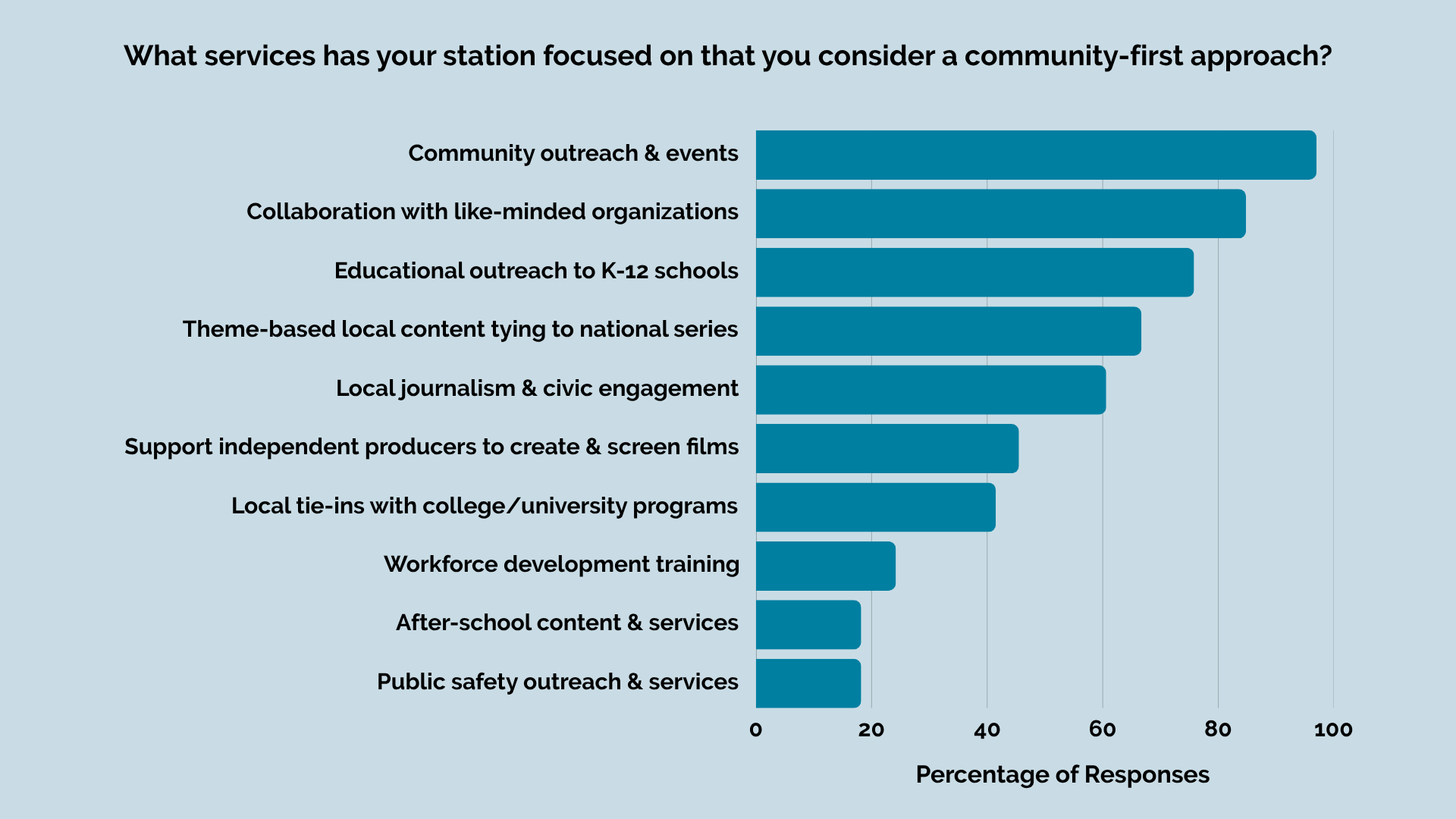
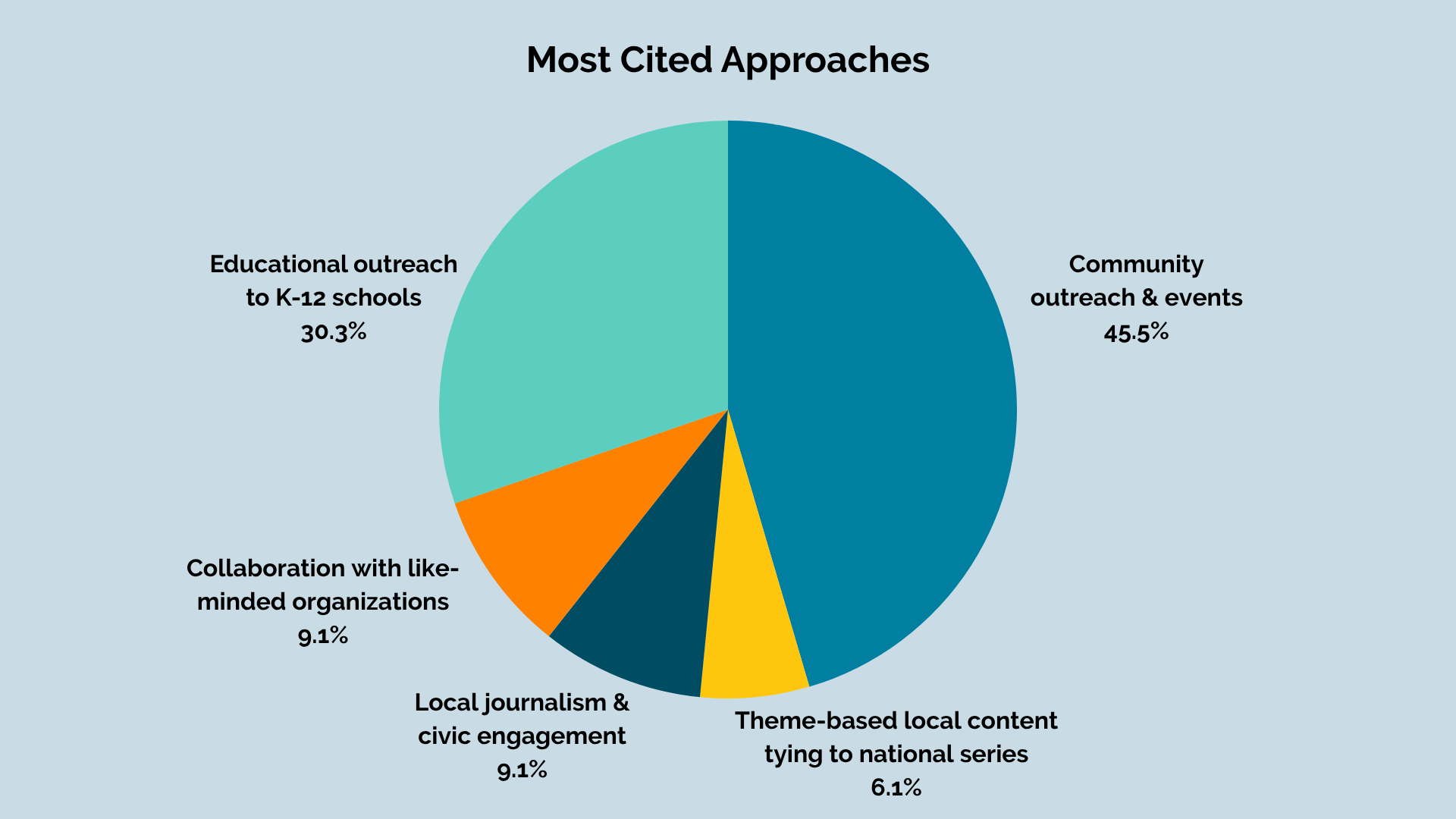
Thank you to everyone who took the time to share your community-first efforts. Your responses do more than inform a survey; they reflect the depth, reach, and real-world impact of your work every day. The below chart summarizes your responses to help visualize the collective impact.
What stands out clearly is that this is not just about programming or services. It’s about connection. From community outreach and events to local journalism, educational engagement, and partnerships with like-minded organizations. You are building the fabric that holds communities together. You are creating spaces where people feel seen, informed, and engaged.
The strong emphasis on collaboration and community-based work reinforces something important: public media’s value is not transactional, it is relational. It lives in trust, relevance, and presence. Whether you’re working with K-12 schools, supporting independent creators, or tying local stories to national conversations, you are ensuring that community voices are not only heard, but amplified.
Even the areas with fewer responses, like workforce development or public safety outreach point to opportunities, not gaps. They signal where future growth can deepen impact and extend your mission even further.
Your work matters because it strengthens civic life, fosters understanding, and builds more informed and connected communities. This survey simply makes visible what you already demonstrate every day: that public media, at its best, is not just a broadcaster, it is a vital community partner.
Your efforts reinforce a simple but powerful truth: A community-first approach isn’t just a strategy, it’s a commitment. It means showing up consistently, valuing relationships over transactions, and measuring success not just by output, but by the strength of the connections we help create.

The Value of Public Media Stations Moving to a Community-First Platform
By Milton Clipper
In an era of fragmented media, declining local journalism, and growing mistrust in institutions, public media stands at a pivotal crossroads. To remain vital, relevant, and deeply connected to the people they serve, stations must embrace a community-first approach. An approach that elevates local voices, responds to community needs, and places public service at the center of every decision. A community-first platform is more than a strategy. It is a recommitment to the founding ethos of public media: strengthening democracy and fostering an informed, engaged public.
At its core, a community-first model shifts public media from a top-down broadcast structure to a participatory, locally grounded ecosystem. Instead of shaping content around assumptions about audience interests, stations root their work in genuine understanding of local priorities. This means amplifying the stories and issues that matter most, from neighborhood development and local elections to cultural celebrations and the concerns of historically marginalized groups. In a media landscape dominated by national narratives, this hyper-local lens becomes a powerful differentiator and a lifeline for communities hungry for trustworthy, contextual information.
The first building block of this approach is deep local connection. Public media stations that prioritize local news and programming not only fill gaps left by diminishing local newspapers but also strengthen civic awareness. Investigative reporting on local governance, environmental issues, or public services gives residents the insight they need to participate meaningfully in civic life.
Community forums, citizen-led reporting, and collaborative projects further extend the reach of local storytelling, transforming audiences from passive consumers into active participants and supporters. Partnerships with schools, nonprofits, cultural organizations, and advocacy groups can enrich this work by bringing a wider range of lived experience and expertise into editorial spaces.
Equally important is expanding access. A community-first station reflects the collective thinking of the region it serves; its languages, perspectives, cultures, and abilities. This requires intentional representation in programming, improved digital accessibility, and a real commitment to reaching rural and underserved areas. By leveraging social media, on-demand platforms, and multilingual content, stations can ensure that every audience member can engage on their terms and at their convenience.
Engagement, the heartbeat of a community-first model, must be ongoing and reciprocal. Interactive tools, social media conversations, online polls, community surveys, and regular town halls help stations stay attuned to local priorities. These feedback loops do more than improve programming; they build trust, transparency, and authentic relationships. When audiences see their input reflected on-air or online, they recognize public media a valued platform worthy of their support.
Embracing community-first strategies also strengthens financial sustainability. Membership models tied to local content, community-based fundraising events, and partnerships with local businesses and institutions create a shared sense of ownership. Grants aimed at cultural preservation, education, or community development provide additional support for initiatives that directly serve local audiences.
Ultimately, a community-first shift is both a cultural and institutional transformation, one that amplifies emerging voices, taps into collective community wisdom, and stays responsive as communities grow and change. Stations that embrace this future will not only reinforce their role as trusted public institutions but will help build more informed, connected, and resilient communities.
A community-first platform doesn’t just serve communities; it helps build them. As a trusted, neutral convener, public media brings together community members, civic leaders, and local organizations to listen, learn, and collaborate. In doing so, a community-first approach creates civic capacity and reinforces the relationships that make informed, resilient communities possible. That’s public media at its best: turning shared trust into shared progress.

NEW Service – Mergers & Combinations
NETA Consulting now offers support for organizations exploring mergers, strategic combinations, or shared-service models. Our team helps leaders evaluate opportunities to consolidate operations, align governance, and integrate systems in ways that strengthen long-term sustainability. Several of our consultants have direct leadership experience in planning and implementing mergers or strategic partnerships.
Whether the goal is to enhance organizational resilience or expand regional impact, we provide guidance through every stage—from early exploration and transition planning to implementation. We would be glad to sit down with you and your team and map out a strategy and proposal.