How much should public media disclose when AI touches its content? Too little disclosure, and audiences feel misled. Too much, and every piece of work starts to look suspect.
NETA Webinars
NETA webinars allow our members to participate in engaging discussions on a variety of topics to increase skills and strengthen the long-term commitment to public media's education mission. We work closely with thought leaders throughout the system, including our PLC Executive Committees, to produce timely and content-rich online events.
Archived NETA webinars and all associating materials can be found on publicmedialearns.org.
Fill out this form(opens in a new tab) if you're interested in hosting a webinar, or contact us with any questions you may have.
You must be signed into Public Media Learns and enrolled in the NETA Webinar Archives course for the archived webinar links below to work. If you don’t have a PML account, you can create an account through requesting to be added to the Webinar Archive course. Go to the Webinar course and click Enroll Now. Fill out the form and click Register New Account.
to
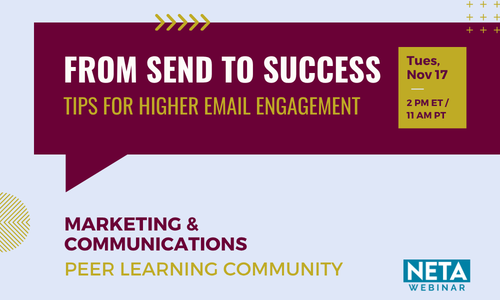
Energize your email campaigns and e-newsletters! This webinar has a panel of local PBS stations covering news, events, programming, and membership emails. We’ll share tips, tricks, and ideas with real examples and success stories.
Learning Goals:
- Easy Email Strategies to Improve Engagement
- Ideas for growing your email topics and lists
to
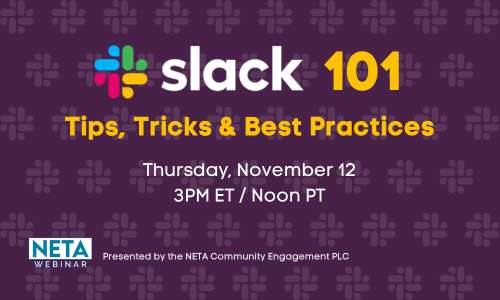
Join the Community Engagement Peer Learning Community for a practical introduction to Slack and discover how public media professionals use it to stay connected, share knowledge, and collaborate more effectively. We'll cover key features, helpful workflows, and proven strategies for keeping conversations organized and teams engaged. You'll also learn how to join the official NETA Community Engagement PLC Slack group.
Learning Goals / Key Takeaways:
- Use Slack more effectively to communicate, collaborate, and build connections with colleagues
- Explore tools and workflows for organizing conversations, sharing resources, and managing information

to
What if the content you're creating for digital could have a second life on broadcast?
Join your public media peers for an exploration of how stations are moving content between digital and broadcast platforms to extend reach, maximize resources, and create stronger connections with audiences. Through real-world case studies, presenters will share how they identify digital content with broadcast potential, adapt stories and formats for different platforms, and build workflows that allow teams to think beyond a single distribution channel.
This session will focus on practical examples that stations can replicate, from short-form digital content finding a home on television or radio, to broadcast content being reimagined for digital audiences. We'll explore what makes content transferable across platforms, how teams collaborate to make it happen, and what stations have learned along the way.
Whether you're working with a large content team or limited resources, you'll leave with ideas for getting more value and reach from the content you're already creating.
By the end of this session, participants will be able to:
- Learn how stations are evaluating digital content, stories, and formats that can be adapted for broadcast—and vice versa.
- Explore practical models for repurposing and adapting content.
- Develop strategies for stronger cross-platform workflows.
to
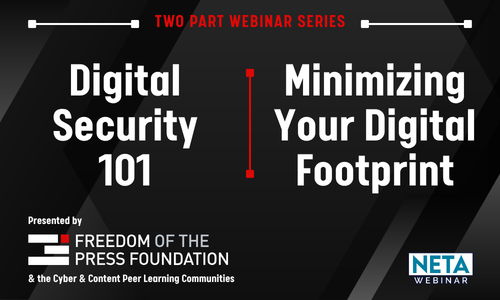
Join the Freedom of the Press Foundation(opens in a new tab) and the Cyber and Content PLCs for part two of this two-part webinar series.
Part two of this series focuses on reducing risks concerning privacy. The session guides participants through the process of identifying, scrubbing, and restricting personal information that is publicly available, while also providing practical strategies to limit the tracking of behavior and activity across devices and communications.
Participants will learn the fundamentals of minimizing risk to information available through public sources and through data generated from our personal and work devices:
- Where to find your personal information online
- How to scrub/restrict personal information from online sources
- Minimizing behavior tracking via your devices and communications
This webinar will not be recorded; participants must attend live. Third-party AI notetakers, recording bots, and automated transcription services are not permitted during either presentation.
Archived Webinars
Learn about the new Middle School Science Collection for PBS LearningMedia! GBH's latest collection is designed to meet the urgent need for high‑quality, media‑rich science resources for grades 6–8 across the country.
Immersive storytelling is showing up more often in public media, from augmented reality installations that put people inside a story to virtual reality tours built for classrooms. This session, co-presented by Public Media Innovators and the Content PLC executive committee, takes a close look at immersive experience design through working examples from across public media.
As AI rapidly becomes the new way people find and make sense of information, AI systems are disrupting social platforms and news providers alike. For public media stations that are built around community and trust, that shift raises the question: will people still come to us, or chat with AI instead? And what happens to the relationships we've built with our audience and our members?
Great content doesn't happen by accident. It emerges from organizations that are intentionally designed to support creativity, collaboration, and continuous improvement.
Too often, leaders respond to symptoms like burnout, bottlenecks, unclear priorities, or constant rework by trying to fix individual people or isolated processes. But these challenges are often signals of something deeper: the way the organization itself has been designed.
Through the past tumultuous year, one thing has emerged as a common strength of public media stations - our ability to tell local stories, connect with our communities, and embrace the people and places that support our work at home.
In this session, we will hear from stations that have found new ways to strengthen their local connections, celebrate their community impact, and demonstrate the unique - and essential - power of local public media organizations.
Key Takeaways:
AI is already reshaping the media landscape, and our audiences expect us to have a thoughtful, trustworthy position on it. A strong AI policy is one of the clearest ways to demonstrate that.
In this webinar, presenters from several public media stations will share their experiences developing AI policies from the ground up. We'll cover what drove each station to act, how they structured their policies, and the lessons that came out of the process. Panelists will also share their policies directly, so we can all leave with something concrete to build from.
As public media stations prepare for the next election cycle, the need for trusted, community-centered journalism has never been greater. Join your peers from across the system for an open conversation about election coverage planning, audience engagement, and newsroom strategy.
Public media audiences are already on Reddit, and they're already talking about our content. The question is whether we're in the conversation. PBS News has been answering that question with a thoughtful, evolving strategy: an active subreddit community, live Ask Me Anything (AMA) events, and a multi-platform approach that's helping them reach younger, digitally-native audiences without abandoning the journalism that earned their trust.
Public media organizations are under pressure to do more with fewer resources. How can public media harness AI without compromising trust, transparency, or editorial integrity?